Judge Harrison was about to continue the examination when a sudden noise was heard.
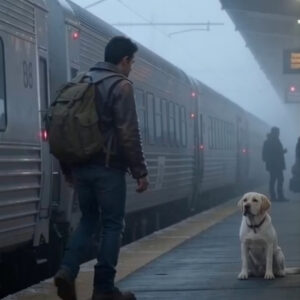
The doors opened slowly. A dog entered. Neither big nor small, just a dog, calm and confident. He stood on the threshold for a moment, then began to walk towards the back of the room.
Noise The clatter of his claws on the floor was the only sound in the entire court. The silence became even deeper. All eyes followed him.
The dog passed in front of the judge, in front of the prosecution table, and stopped right in front of the accused, Jonathan Parker.
The whole room was as if petrified. The judge’s hand hung in the air. A spectator put his hand to his mouth.
Then the dog began to sniff Jonathan.
He sniffed her hands carefully, then her clothes, then her face. Jonathan stood perfectly still, his eyes wide open, holding his breath. On her face was fear and confusion, but also something deeper: a faint spark of hope that seemed long gone.
The dog circled around him several times, then came back and sniffed his palms again. Then he sat down next to Jonathan and rested his head on his lap.
A silence reigned in the court. But this time, that silence was different. It was no longer the silence of tension, but that of surprise, of reflection, the silence of a beginning.
Judge Harrison lowered his hand. On his face appeared for the first time something that looked like a doubt, not about the accused, but about all that he had hitherto held to be right.
“What does that mean?” he asked, but his voice was not as confident as it had been before.
Jonathan’s lawyer, young Amelia Brown, stood up and said, “Your Honour, I think that dog is trying to tell us something.”
The judge looked at the dog, then Jonathan, who stroked the animal’s head with his trembling fingers, while tears shone in his eyes.
“Let’s go on,” the judge said, but this time his voice had a different tone: no longer that of a judge, but that of a man who had suddenly understood that sometimes the truth comes in the most unexpected form.
Jonathan Parker had been waiting for this day for three months. Three months during which he had lost his job, most of his friends, and almost lost faith in justice. He was accused of something he hadn’t committed, but the evidence presented by the prosecution seemed so convincing that even his own lawyer, Amelia, sometimes doubted that Jonathan had told her the whole truth.
Amelia was young, scarcely thirty-two years of age, and this was her first great business.
She worked day and night, looking for the slightest flaw, the slightest thing that could save her client, but each time she came up against closed doors. Until now.
That morning, Jonathan had woken up with a particular feeling of heaviness. He knew that the judge could deliver his verdict today. He had looked in the mirror and seen a man who couldn’t remember the last time he had smiled sincerely.
He had washed, put on his only suitable suit, a little too loose now because in recent months worry had made him lose weight, and he had left the house without breakfast, his throat in a knot.
In court, everything had started as usual. The attorney general, Thomas Weston, a seasoned and formidable speaker, had once again presented his arguments. He spoke confidently, fluently, as if he already had his victory. He looked at the members of the jury one by one, and they nodded their heads, approved, believed him. Jonathan watched all this and felt the ground give way under his feet.
Amelia tried to oppose, to bring counter-arguments, but her voice sounded much weaker than Weston’s, and she felt it herself.
It was at that very moment, when Jonathan had almost given up hope, as the last spark was extinguished in his eyes, that what was to change everything happened.
The doors of the tribunal opened, and a dog entered.
At first, Jonathan didn’t understand what was happening. He heard the creaking of the door, saw all heads turn, heard the murmurs like the rustling of dead leaves, and then he saw the dog. The dog was walking towards him. Not to the judge, not to the prosecution, but to him. Jonathan’s heart began to beat so hard that he thought everyone could hear him.
When the dog approached and began to sniff his hands, Jonathan noticed something that made him shudder from within. The dog was neither aggressive nor suspicious, but attentive, almost tender. He sniffed his palms as if he was looking for something that only he knew where to find. Then the dog pulled himself up and sniffed his face. Jonathan felt her warm breath on his cheeks and suddenly closed his eyes. In that moment, he remembered something he had forgotten for years.
He remembered his childhood. He remembered a dog they had in their garden when he was seven years old. This dog always came to him when Jonathan was sad, came up, put his head on his lap, and looked at him in a way that always warmed Jonathan’s heart.
This dog had disappeared when Jonathan was ten years old, and he had cried for months, in secret, at night, so that his parents would not hear him. Then life went on, and he forgot about that feeling. Until now.
The dog sat down by his side and rested his head on his lap. Tears rolled down Jonathan’s cheeks. He did not try to hide them. He stroked the dog’s head with his trembling fingers and felt that, for the first time in months, something was warming up in his chest.
Judge Harrison was watching this scene and could not take his eyes off it. He was a man who had worked twenty years in the judicial system, who had seen hundreds of cases, thousands of people, but never anything like this. Something moved inside him. Thomas Weston, the attorney general, also looked on and felt his confidence waver. He didn’t understand what was going on, but he felt that the atmosphere in the room had changed.
Amelia, who until that moment had felt like a loser, suddenly felt a strength born within her. She rose, her voice now more assured, clearer. She asked the judge to pay attention to the fact that this dog, which had no connection with this case, had spontaneously approached Jonathan and no one else.
She asked, “Your Honor, how can an animal that hasn’t read the file, that doesn’t know anything about the accusations, choose Jonathan and sit by his side as if to protect him?”
In the court, there was silence. Then Judge Harrison spoke, and in his voice, for the first time, there was something that sounded like a doubt about the judicial system itself, the one he had served all these years. He says, “I don’t know what it means, but I can’t ignore what I see with my own eyes.”
He postponed the verdict and ordered a further investigation. A week later, new evidence was discovered, evidence that showed Jonathan was innocent. It turned out that the prosecution’s main witness had lied, and that some of the evidence had been fabricated. Jonathan was acquitted in the courtroom, a smile on his face, tears in his eyes.
After the trial, as Jonathan was leaving the courthouse, he saw the same dog, sitting on the steps, as if waiting for him.
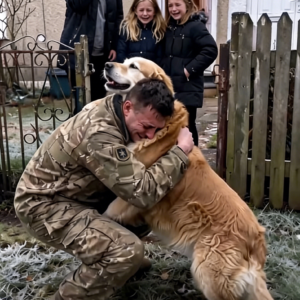
Jonathan approached, crouched down, took the dog in his arms and whispered to him, “You saved me.” It was learned that the dog belonged to one of the guards of the courthouse, who took it to work every day, but that day the dog, frightened by something, had escaped and run inside.
Or perhaps it was not fear that guided him, but something deeper, what men sometimes call instinct, but which in reality goes far beyond all instinct.
It is this bond that exists between all living beings, this language that is spoken without words, this love that comes not from the mind but from the heart.