More than a century after the RMS Titanic sank beneath the icy waters of the North Atlantic, one mystery continues to intrigue experts and the public alike — why have no human remains ever been discovered among the wreckage? Despite decades of exploration and dozens of dives to the site, no skeletons have ever been found — and science may finally explain why.

Discovered in 1985, the Titanic rests roughly 12,500 feet below the surface — a depth that presents enormous challenges not just for divers and submarines, but also for the preservation of anything organic. According to oceanographers, the ship lies far below what’s known as the “calcium carbonate compensation depth” — a point in the ocean where bones, shells, and other calcium-based materials begin to dissolve due to the chemical makeup of the deep-sea water.
Deep-sea explorer Robert Ballard, who led the expedition that found the Titanic, told NPR that this environment makes bone preservation virtually impossible. “Once scavengers remove the flesh, the bones are exposed to water that’s undersaturated in calcium carbonate,” Ballard explained. “At that depth, they dissolve completely.”
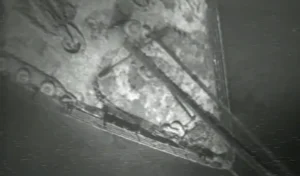
That scientific reality helps explain why, even though more than 1,500 passengers and crew perished when the Titanic went down in April 1912, no trace of their remains has been located. The ship sits nearly two and a half miles beneath the ocean’s surface — an area teeming with scavenging organisms that consume anything organic long before decomposition can be observed.
Filmmaker James Cameron, who has visited the Titanic wreck more than 30 times, confirmed this eerie absence. “We’ve come across clothing and even pairs of shoes — clear signs that people were once there,” Cameron said in a 2012 interview with The New York Times. “But I’ve never seen human remains.”
The tragic sinking claimed about 68% of the 2,200 passengers and crew aboard. While many died from drowning or hypothermia, experts believe most wore lifejackets that initially kept their bodies afloat. Powerful storms in the days following the disaster likely carried those bodies far from the site, where they eventually sank or were consumed by marine life.
And while bones have been recovered from much older shipwrecks in shallower waters, the Titanic’s extreme depth — coupled with harsh underwater chemistry — ensures that little trace of the victims could survive more than a century.
Still, some researchers have speculated that sealed areas within the ship, such as the engine room or storage compartments, might have protected remains from deep-sea conditions. Yet after 111 years, the odds of discovering preserved bodies are increasingly slim.
What does remain are haunting reminders — shoes, coats, and other personal items frozen in time — marking the spots where lives once were. The absence of human remains only deepens the ship’s tragic legend, reminding the world that nature, time, and depth have reclaimed nearly every trace of the Titanic’s final hours.